




Recently viewed


How to Choose the Right Cantilever Umbrella for Your Outdoor Space
Cantilever umbrellas offer a distinct advantage over traditional patio shades: they are supported from the side and provide unobstructed coverage for your outdoor furniture. This design makes them especially popular for patios, pool areas and deck spaces where maximising usable area matters.
You will need to review several key factors to choose the right cantilever umbrella. Canopy size options, including large cantilever umbrella choices, must be considered. Select an appropriate cantilever umbrella base for stability and think over frame materials along with adjustment features. This guide walks you through each decision and helps you find the right cantilever patio umbrella for your outdoor space.
Understanding Cantilever Umbrella Basics
What Makes Cantilever Umbrellas Different
The engineering approach defines the key feature. A cantilever patio umbrella uses a side-mounted pole with a horizontal arm extending overhead rather than a vertical shaft running through the canopy's centre. This offset configuration positions the support structure outside your shaded area.
The mechanical advantage becomes clear when you compare functionality. A traditional centre pole umbrella anchors shade above its base. You build your furniture arrangement around that fixed point. The cantilever design reverses this relationship. You place the pole to the perimeter and the canopy floats over your seating area. No compromises on furniture layout or foot traffic patterns.
Most cantilever umbrella models incorporate 360-degree rotation around the base pole. This rotational capability pairs with multi-angle tilt mechanisms that adjust in multiple directions. You reposition the shade without relocating furniture or the heavy base as the sun moves across the sky throughout the day. Some models can withstand winds up to 43 km/h when anchored, with heavy-duty versions rated for 60 km/h.
The canopy size and reach need different structural considerations. Heavier bases (ranging from 70 to 180 kg) counterbalance the offset weight distribution. The engineering demands explain why these umbrellas require more robust construction compared to centre pole alternatives.
Key Benefits for Outdoor Spaces
Cantilever umbrellas solve specific outdoor shading challenges that centre pole designs cannot address:
- Complete coverage freedom: The absence of a central support creates unobstructed access underneath. You arrange seating, loungers, or dining furniture without working around a pole positioned in the middle of your space.
- Adaptive shade control: Rotation and tilt features let you track the sun's path from a fixed base position. This adjustability extends usable outdoor hours without repositioning.
- Temperature and UV reduction: A well-positioned cantilever umbrella can reduce surface temperatures beneath the canopy by over 11°C while blocking 99% of UV rays when using UPF 50+ rated fabrics.
- Visual integration: The suspended design adds architectural interest to patios and pool areas. Available in octagonal, square, and rectangular canopy shapes, these umbrellas complement various outdoor aesthetics without dominating sight lines.
The rotational capability proves valuable. A cantilever umbrella with full rotation provides shade coverage to up to four times the area of a stationary umbrella with comparable canopy size. You are multiplying your shaded space through mechanical advantage.
Common Uses and Placement Options
Pool decks represent the most popular application. The offset design positions shade over lounge chairs and pool edges without creating obstacles in high-traffic zones. Commercial facilities favour this setup to maintain clear sightlines and eliminate tripping hazards.
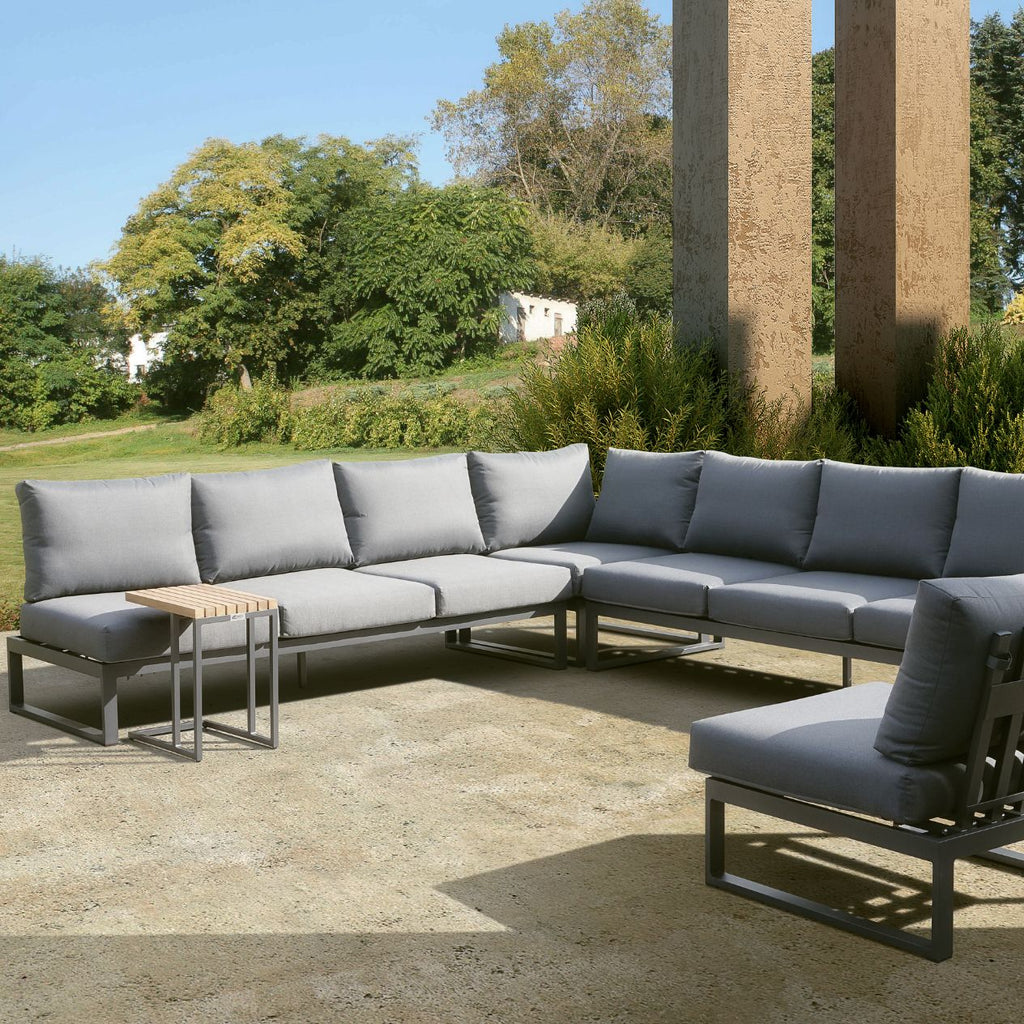
Outdoor sectionals and L-shaped seating arrangements benefit as well. These furniture configurations lack a natural centre point for a traditional pole. A cantilever umbrella positioned at the perimeter covers the entire seating area from one anchor point.
Hot tub surrounds present similar advantages. You need overhead protection, but there is no practical location for a centre pole that does not interfere with entry and exit.
Think about sun trajectory across your space when you select placement. An outdoor area facing west receives different sun angles than an east-facing patio. Mark the umbrella's footprint before installation and account for the canopy diameter plus base offset. A 270 cm canopy needs 300 to 340 cm of clear space in the extension direction, plus 60 cm for the base footprint.
You have several mounting options depending on your property type. Freestanding bases (fillable with sand or water) work for rental properties or spaces where permanent installation is not feasible. Many include wheels to reposition between multiple shaded zones. Wall-mounted brackets attach to exterior walls for patio applications. Bolt-down mounts secure the pole to concrete decking, ideal for poolside installations. In-ground mounting provides the most permanent solution for yard or garden placements.
Wind direction matters as well. Position the cantilever umbrella so winds approach from the side rather than catching the full canopy face-on. This reduces stress on the frame and base system.
Selecting the Right Canopy Size and Shape
Measuring Your Outdoor Space
Your canopy should extend roughly 60 cm beyond the edges of your furniture on all sides. This overhang accounts for sun angle changes throughout the day. Direct light still hits seated guests at their shoulders and laps when shade stops exactly at your table's perimeter.
Pull dining chairs into their occupied positions before measuring. The shaded area needs to cover not just the table surface but the full footprint people actually use. A rectangular dining table measuring 90 cm by 210 cm would need 60 to 90 cm added to both dimensions. This requires a 210 cm by 270 cm canopy.
Round umbrellas follow different measurement conventions than square models. Manufacturers measure round canopies from tip to tip across the diameter. Square and rectangular canopies get measured along their perimeter sides. This creates confusion when comparing sizes. A 230 cm square umbrella provides more coverage than a 270 cm round umbrella because the square's ribs extend further from centre.
Account for clearance beyond just the canopy spread. A 270 cm cantilever umbrella needs 300 to 340 cm of space in the extension direction when you factor in the offset arm and rotation radius. The base adds another 60 cm to your total footprint calculation.
Choosing Between Round, Square, and Rectangular Canopies
Shape selection affects both shade coverage and visual integration with your space. Square umbrellas provide more protection than round options at similar listed dimensions. The angular design fits snugly against walls and corners and maximises shaded areas in compact patios. Square canopies sit flush without wasting gaps when positioning multiple umbrellas side by side.
Round canopies create symmetrical coverage spreading evenly in all directions. They work well with circular tables or flexible seating arrangements that change throughout the day. The curved edges shed wind more effectively than flat surfaces and make them suitable for exposed locations.
Rectangular shapes align with long dining configurations and poolside lounge setups. They create room-like overhead coverage for six to ten person gatherings. Rectangular canopies require heavier bases and more clearance space compared to round or square alternatives.
Shape-specific advantages:
- Round: Available in many styles, uniform 360-degree shade distribution and better wind shedding
- Square: 30% more shade area than equivalent round size, corner-friendly placement and modern architectural aesthetic, efficient for rectangular tables
- Rectangular: Superior coverage for elongated dining sets, often has tilt and rotation features, ideal for lounge configurations
Square umbrellas measure taller than round models due to extended rib length. Check the manufacturer's closed clearance specification if you plan to use the cantilever umbrella over a dining table. Some square cantilever models lack sufficient ground clearance when collapsed.
Large Cantilever Umbrella Options for Bigger Areas
Cantilever umbrellas span 240 to 400 cm in diameter. A 300 cm square canopy delivers up to 9 m² of shade. Specialty options reach 490 cm or larger for commercial applications.
Match canopy size to your furniture scale. A 240 to 300 cm umbrella covers two to four people at café tables or compact spaces. Standard patios with four to six person dining sets require 300 to 370 cm canopies. Entertaining eight to ten guests requires 400 to 460 cm coverage.
Specific furniture pairings follow predictable patterns. Bistro sets pair with 210 to 240 cm canopies covering up to 90 cm of shade diameter. A four-person dining set needs 240 to 270 cm coverage for 120 cm of shade. Six to eight person tables need 340 to 370 cm umbrellas providing up to 210 cm of shade diameter.
Large sectionals and eight to ten person dining configurations need 370 to 400 cm canopies delivering 240 to 270 cm of coverage. Commercial installations serving ten or more people benefit from 490 cm and larger cantilever umbrella options.
Base weight scales proportionally with canopy size. Cantilever umbrellas require bases weighing 180 kg or more to support the offset centre of gravity. Larger canopies need heavier anchoring systems to prevent tipping during wind events.
Evaluating Canopy Materials and Fabric Types
Fabric selection directly affects how long your cantilever patio umbrella performs and maintains its appearance. The canopy endures constant exposure to sun, rain, wind and environmental pollutants. Different materials have distinct trade-offs between protection levels and replacement frequency.
Polyester Fabric: Standard Choice
Standard polyester appears in most entry-level cantilever umbrella models. Made from synthetic petroleum-based fibres, this lightweight material delivers a shorter outdoor lifespan. Noticeable fading or material degradation occurs after regular use in harsh conditions.
Multi-layer polyester fabric weighs 240 gsm with UV-resistant treatment and hydrophobic coating for water repellency. Standard polyester lacks UV stability compared to higher-grade options. It may sag or stretch over time.
Solution-dyed polyester bridges the gap between standard and premium options. This heavy-duty version handles extreme weather conditions including rain and heavy storms. Solution-dyed methods produce fade-resistant fabric with rich colouring that retains vibrancy. The fabric blocks 98% of UV rays.
Acrylic: Premium Option
Solution-dyed acrylic locks colour into each fibre before spinning and creates ultra fade-resistant material. Premium acrylic weighs 270 gsm and blocks 98% of harmful UV rays. The fibres are saturated to the core with UV-stabilised pigments. Colours stay brilliant without damage from sun exposure.
Premium acrylic fabrics withstand sun, wind and rain through durable woven construction. The material resists mould and mildew, maintains integrity through easy cleaning and allows air to pass through for breathability. UPF 50+ protection with superior fade resistance makes solution-dyed acrylic the top-performing canopy material for a cantilever umbrella exposed to Australian conditions.
Olefin fabric provides mid-tier performance. This polypropylene solution-dyed material weighs 200 gsm and blocks 95% of harmful UV rays with UPF 40 rating. Olefin delivers strong moisture and mildew resistance with quick-drying properties.
Heavy-duty acrylic fabric weighing 300 gsm blocks 99.9% of harmful UV rays through air-textured yarn construction. This extreme thickness provides superior UV resistance performance.
UV Protection and Weather Resistance
UV protection serves dual purposes: shielding people underneath and preserving the fabric itself from sun damage. UPF 50+ certification indicates blocking 98% or more of UV rays.
Water resistance depends on fabric finish and weight. Look for canopies weighing at least 300 gsm for optimal weather performance. Solution-dyed fabrics repel water better than standard weaves.
All quality outdoor fabrics resist mould and mildew. Acrylic fabrics excel in humid conditions because of their moisture-resistant properties.
Fade Resistance and Longevity
Colourfastness ratings indicate fading resistance over time. AATCC 16 Grade 5 certification represents top-tier UV fading resistance. Fabrics passing this standard retain vibrant colour through prolonged sun exposure.
Solution-dyed acrylic maintains appearance longest, followed by solution-dyed polyester and then standard polyester. When choosing a cantilever umbrella for Australian conditions, prioritise solution-dyed fabrics for their superior UV stability.
Choosing the Right Cantilever Umbrella Base
Base stability determines whether your cantilever umbrella base withstands wind gusts or tips during operation. The off-centre weight distribution of cantilever designs creates unique anchoring needs compared to traditional centre-pole models.
Why Base Weight Matters
Cantilever umbrellas require heavier bases than standard patio umbrellas. The side-mounted pole creates a leverage effect. The hanging canopy acts as a sail and catches wind. This multiplies force against the base. An inadequate base poses risks to people, furniture and the umbrella itself.
Weight requirements scale with canopy dimensions. Umbrellas below 240 cm need a base weight of 30 to 40 kg. You need 90 to 100 kg to offset the leverage effect between 240 and 270 cm. Umbrellas spanning 270 to 340 cm require at least 130 kg. The largest cantilever umbrellas exceeding 340 cm need bases exceeding 150 kg or permanent mounting solutions.
Windy locations require additional weight beyond these baseline figures. Add 25 to 50% extra capacity if your area experiences frequent strong winds. Most cantilever umbrella bases comprise rigid plastic shells filled with sand, galvanised steel plates stacked together, or heavy timber and steel blocks fitted into base structures.
Fillable vs. Pre-Weighted Bases
Fillable bases offer customisable weight and portability advantages. These hollow plastic or resin shells accept sand, water or concrete as ballast. Smaller fillable models hold up to 20 kg of material. Larger cantilever-specific versions accommodate up to 190 kg when filled with sand and water mixture.
Fill sand first until nearly full and then add water to occupy gaps between sand grains. This method maximises density and weight capacity. The high-density polyethylene construction resists cracking and fading in various weather climates. Moulded handles help movement when empty.
Pre-weighted bases arrive ready for immediate use. Steel plate models weigh 45 kg with anti-rust primer coating and stainless steel hardware. Cantilever rolling bases feature frames that weigh 70 kg and hold up to 135 kg of additional sand. These bases enable the umbrella's 360-degree rotating swivel function.
Concrete bases deliver maximum durability but sacrifice mobility. Steel and concrete options require minimal setup but lack the repositioning flexibility of fillable alternatives.
Wheeled Bases for Easy Mobility
Wheeled bases combine weight with relocation capability. The average wheeled base weighs 45 kg. Basic designs have two rear wheels that require tilting for movement. Larger commercial models feature four wheels with lockable casters.
Advanced wheeled systems include foot pedals that lock and unlock wheels. One-handed movement mechanisms with adjusting levers let you lift the base, unfold wheels and reposition without assistance. Four-wheel bases provide balanced push-and-pull movement without tilting and make them safer for canopies spanning 340 cm or more.
Wheeled bases maintain stability through retractable or removable wheel systems that do not interfere when stationary. Look for reinforced wheel mounting points and low centre of gravity designs.
Matching Base to Canopy Size
Base compatibility extends beyond weight calculations. Cantilever umbrellas require bases designed for their specific manufacturer and model. Small model modifications over time mean the umbrella's specifications affect compatibility. Confirm your base and umbrella match in both brand and model specifications.
Check pole diameter compatibility. Most umbrella poles measure 4 cm in diameter, though sizes range from 3 to 8 cm. Verify the base opening accommodates your pole size to prevent wobbly installation.
Assessing Frame Construction and Durability
Frame quality separates long-lasting cantilever patio umbrellas from models requiring replacement within seasons. The pole, ribs, and hardware components determine whether your umbrella withstands daily use or buckles during the first windstorm.
Aluminium vs. Steel Frames
Aluminium frames dominate the best cantilever umbrella options due to their strength-to-weight ratio. These frames resist corrosion and eliminate the rust problems that plague steel alternatives. Aluminium does not degrade in outdoor environments and provides reliable performance over extended periods.
Umbrellas featuring aluminium frames with steel ribs offer standard construction suited for residential use. Heavy-duty aluminium frames with aluminium ribs feature thick poles and durable ribs with powder coating, making them suitable for commercial applications. Marine-grade aluminium delivers the highest corrosion resistance for coastal environments where salt air accelerates deterioration.
Steel frames carry notable drawbacks. They rust and wear down, especially in damp or coastal areas. The increased weight makes steel frames harder to move and set up compared to aluminium alternatives. Steel needs extensive maintenance to prevent corrosion. You must clean it, remove rust, and apply protective coatings. These maintenance demands increase the total effort required over the cantilever umbrella's lifespan.
Fibreglass frames offer better wind resistance through flexible construction. Fibreglass bends and flexes during wind gusts without cracking or breaking. Ribs constructed from solid 2 cm diameter fibreglass allow maximum flexibility. Fibreglass ribs snap back into position rather than bending permanently when gusts hit.
Powder-Coated Finishes for Rust Protection
Powder-coating creates a protective barrier against rust and corrosion. This finish treatment extends frame lifespan in harsh weather conditions. Anodisation provides an alternative protection method for aluminium through an electrochemical process that forms an impermeable aluminium oxide layer. This surface resists rust, tarnish, and scratches while deeply absorbing pigments for lasting colour.
Rib Count and Support Structure
Rib quantity affects structural stability. An 8-rib structure provides better support and greater wind resistance than 6-rib construction. Thicker, stronger ribs reduce wobble and deformation risks. But rib count alone does not guarantee durability. Joint quality and canopy materials affect longevity just as much.
Wind Vents for Added Stability
Wind vents function as pressure release mechanisms. These fabric flaps positioned above the canopy dome allow air to escape during gusts. Vented canopies reduce the risk of the cantilever umbrella acting like a sail and tipping over. Vents also allow hot air to escape upward and cool the shaded area below. Double wind vents appear on heavier-duty models designed for high-wind environments.
Considering Adjustability and Features
Operational flexibility determines how well your cantilever umbrella adapts throughout the day. Adjustment features change static shade into responsive coverage that tracks sun movement and accommodates changing outdoor conditions.
360-Degree Rotation Capabilities
Full rotation allows the canopy to pivot in a complete circle from a fixed base position. Most models incorporate foot pedal mechanisms that release the pole for easy repositioning. You press the pedal, swivel the umbrella to your desired angle and release to lock it in place. Built-in rotation handles provide an alternative control method on certain designs. This swivel functionality eliminates furniture rearrangement as the sun shifts from morning to evening.
Tilt Mechanisms and Angle Options
Multi-position tilt blocks low-angle sun during early morning and late afternoon. Push-button release handles require minimal effort to adjust between angle settings, and premium models offer six different positions. Some cantilever patio umbrellas provide up to 120-degree tilt adjustment. Crank-based tilt systems use the same handle that opens the canopy. You continue to crank past full extension to activate angle changes.
Built-in LED Lights and Solar Power
Solar-powered LED systems extend outdoor use into evening hours. Canopy ribs accommodate 24 to 32 LED bulbs depending on rib count. Solar panels mounted atop the canopy collect energy during daylight and power lights for approximately six hours after sunset. Select models offer warm and cool light temperature options.
Crank Systems and Ease of Operation
Crank mechanisms simplify opening and closing heavy canopies. You turn the handle in one direction to raise the cantilever umbrella and reverse to lower it. Opening mechanism alternatives include manual lift and push-button auto-open systems.
Conclusion
Selecting the right cantilever umbrella makes a genuine difference to your outdoor comfort and usability. The decisions you make regarding canopy size and frame construction affect your satisfaction across many seasons. The coverage flexibility and unobstructed space these umbrellas offer make them a practical choice for Australian outdoor conditions.
Consider your specific outdoor setup: measure the area, account for sun patterns and match base weight to canopy dimensions. Choosing quality materials like solution-dyed acrylic and rust-resistant aluminium frames protects that decision in the long run. The right cantilever umbrella is the one that balances these factors with your specific outdoor requirements.
FAQs
Q1. What are the most important factors to consider when choosing a cantilever umbrella? Focus on canopy size (ensuring it extends 60 cm beyond your furniture), base weight (matching the canopy dimensions — larger umbrellas need 130 to 180+ kg), fabric quality (solution-dyed acrylic or polyester for UV protection and longevity), and frame construction (aluminium frames resist rust better than steel). Also consider adjustment features like 360-degree rotation and tilt mechanisms for optimal sun tracking throughout the day.
Q2. What size cantilever umbrella do I need for my patio furniture? Measure your furniture with chairs pulled out, then add 60 cm on all sides for proper coverage. Bistro sets need 210 to 240 cm canopies, four-person dining sets require 240 to 270 cm, six to eight person tables need 340 to 370 cm, and large sectionals or eight to ten person configurations require 370 to 400 cm canopies. Square umbrellas provide about 30% more shade than round umbrellas of the same listed size.
Q3. Why is the base weight so critical for cantilever umbrellas? Cantilever umbrellas have an offset design that creates significant leverage, making them prone to tipping without adequate counterweight. Umbrellas under 240 cm need 30 to 40 kg bases, 240 to 270 cm models require 90 to 100 kg, 270 to 340 cm umbrellas need at least 130 kg, and umbrellas over 340 cm require 150+ kg or permanent mounting. Insufficient base weight poses safety risks to people and property.
Q4. Which fabric material offers the best longevity for outdoor umbrellas? Solution-dyed acrylic provides the best longevity, with 98% UV protection and superior fade resistance. Solution-dyed polyester offers a strong mid-range option with 98% UV blocking. Standard polyester is the least durable and fades fastest under direct sunlight. For most homeowners, solution-dyed fabrics provide the best balance of performance and durability for Australian conditions.
Visit Our Showrooms
Ordering our outdoor furniture is simple with our secure online purchasing system. However, if you prefer to experience the quality firsthand, why not visit any of our 7 outdoor furniture showrooms across NSW, VIC, and QLD. Our showrooms are located in Sydney, Melbourne, Brisbane, the Sunshine Coast, and the Gold Coast. At each location, our friendly and knowledgeable team members are ready to assist with your outdoor furniture needs.
At Remarkable Outdoor Living, we offer more than just cantilever umbrellas – we showcase a comprehensive range of outdoor furniture to elevate your outdoor living spaces. Our extensive selection includes Outdoor Lounges, Outdoor Chairs & Benches, Outdoor Tables, Outdoor Dining Sets, Outdoor Bar & Balcony Furniture, Outdoor Daybeds & Sunlounges, Outdoor Umbrellas, Outdoor Cushions & Accessories, and more. We are also the #1 Australian retailer for popular brands like Nardi Furniture, Couture Jardin Furniture, EcoSmart, and Heatsope.