





Recently viewed


Balcony Dining Setting Buying Guide: How to Choose Balcony Table and Chairs That Fit, Stay Put and Stay Safe
Buying a balcony dining setting looks like a smaller version of buying for a backyard. Pick a style, pick a size, check the material, done.
It isn't. A balcony adds four constraints a backyard never has. The space is usually deep in one direction and shallow in the other. The floor is a slab with a designed load limit. Wind picks up with every storey. And there's a balustrade between your table and a long drop, which changes where every chair should sit.
This guide takes those four in turn, starting with the one that rules out the most options: depth. By the end you'll know which layout, materials and chair placement suit your balcony dining setting.
Why a Balcony Is Different From a Backyard
Most balcony furniture advice stops at "go compact": fold it, stack it, choose a round table.
What's missing is the reasoning. A round table suits some balconies and wastes space on others. A heavy concrete table solves wind and creates a load question. Stackable chairs save floor space and, stored in the wrong spot, give a toddler a step up to the rail. Good balcony table and chairs come from weighing those trade-offs for your space, not from picking the smallest set on the page.
So before you browse, grab a tape measure. You'll need three numbers: the depth from the building wall to the balustrade, the balcony's length, and the width of the door you'll walk through.
Measure the Depth First: Balcony Table and Chairs by Depth
Length is rarely the problem on an apartment balcony. Depth is. It decides whether the chairs in a balcony dining setting can face each other or have to sit at the ends. NSW apartment design rules set a minimum primary balcony depth of 200 cm for new one- and two-bedroom apartments and 240 cm for three-bedroom apartments, but plenty of older buildings, studios and secondary balconies come in well under 200 cm.
The depth formula
A seated person with their chair pulled in takes up roughly 50 to 60 cm behind the table edge. On a balcony you also need a way past, even if it's a squeeze.
Depth needed = table width + about 55 cm for each side with chairs + a walkway if people need to pass behind
Allow 60 cm or more for that walkway if it's the route from the door to the rest of the balcony. If nobody needs to pass, drop it.
Under 150 cm deep
A face-to-face balcony dining setting won't fit here: a 60 cm table plus two seated chairs already needs about 170 cm. Two layouts work. The first is a small table with the chairs at its ends, running along the balcony's length. A 60 to 70 cm table with a chair at each end uses about 70 cm of depth and leaves the rest as a walkway. The second is a bar-height outdoor bar setting placed against the building wall, never along the rail. It uses very little depth, and the height gives you a view over solid balustrades.
150 to 200 cm deep
This is where most compact balcony table and chairs sets live. A 70 to 80 cm round or square table with two chairs facing each other needs roughly 180 to 190 cm with no walkway behind. At the shallow end, turn the balcony dining setting so the chairs sit along the balcony's length. Round tables make it easier to squeeze past and open the door, and armless chairs that tuck fully under the table give back floor space when the setting isn't in use.
200 to 240 cm deep
A four-seat balcony dining setting becomes realistic. A 90 to 100 cm round table with four chairs needs about 200 to 210 cm of depth. A rectangular table set lengthways, with two chairs on the inside edge, one at each end and nobody on the rail side, keeps a clear strip along the balustrade and seats four comfortably. Allow at least 60 cm of table edge per person, and more if the chairs have arms.
240 cm and deeper
Here a balcony dining setting can seat people on both long sides of a rectangular table and still leave a walkway. This is also where an outdoor extension dining table makes sense: set for two or four day to day, and extended when friends come over. Check that the extended length still clears the door.
Once you have your layout, browse outdoor balcony tables by size first and style second.
Weight: What Your Balcony Slab Is Designed For
Residential balcony slabs in Australia are typically designed for a live load of around 2 kPa, roughly 200 kg per square metre, plus an allowance at the edge.
For a balcony dining setting with two to four chairs, that's usually generous. The real trouble comes from what gets added over time. A 60-litre planter full of wet soil weighs around 80 kg. Line three along the balustrade and you've put a quarter of a tonne on the edge of the slab. So the practical rules are about placement:
Keep the heaviest pieces close to the building wall, where the slab is best supported.
If you choose a solid ceramic or concrete table, skip the row of oversized planters. The table and the pots share one weight allowance.
If your balcony is a cantilever in an older building, ask your strata manager whether there's an engineering report on file before buying anything unusually heavy.
Wind: Light Enough to Move, Heavy Enough to Stay
Wind and weight pull in opposite directions, which is why balcony advice so often contradicts itself. Lightweight furniture is easy to move, but on an exposed upper-floor balcony it can shift, tip or lift in a strong gust. Queensland strata guidance advises putting lightweight outdoor furniture away when it's not in use, especially with wind forecast.
The workable answer for most balcony dining settings is a split approach:
A heavier table. A ceramic outdoor dining table has enough mass to stay put. Place it towards the building wall.
Light chairs that stack. Powder-coated aluminium or resin chairs are easy to carry, and stacked together they behave like one heavier object.
Open backs over solid panels. A solid chair back catches wind like a sail; slatted, perforated or rope backs let gusts through.
A habit, not just a product. When a strong wind warning comes in, stack the chairs against the wall or bring them inside, and close umbrellas.
Child Safety: Where the Chairs Go Matters More Than Which Chairs
If children live in or visit your home, this matters more than colour or style. NSW children's hospital guidance warns that pot plants and outdoor furniture next to a balustrade can be used as a ladder, and most children treated after balcony falls fell from their own home's balcony. Queensland government guidance notes that balustrades more than 4 m above the ground must not have climbable elements, such as horizontal rails, between 150 mm and 760 mm from the floor. Furniture pushed against the rail can undo that protection in seconds.
What that means for your balcony dining setting:
Plan a clear zone along the balustrade, so no chair, stool or table sits against the rail, even with the chairs pushed back.
Keep bar-height furniture against the building wall. A bar stool seat sits around 75 cm off the floor, most of the way up a 1 m rail.
Store stacked chairs against the wall or inside, since a stack is easier to climb than a single chair.
Keep planters and storage boxes off the rail too. They count as climbable.
Keep the balcony door locked when children are inside. Placement reduces risk; it doesn't replace supervision.
Materials and Details That Suit Apartment Living
Frames. Powder-coated aluminium is the default for good reason. It's rust-free, needs no oiling, copes with coastal salt air and is light enough to rearrange on your own. Our balcony dining settings include options built on this kind of frame.
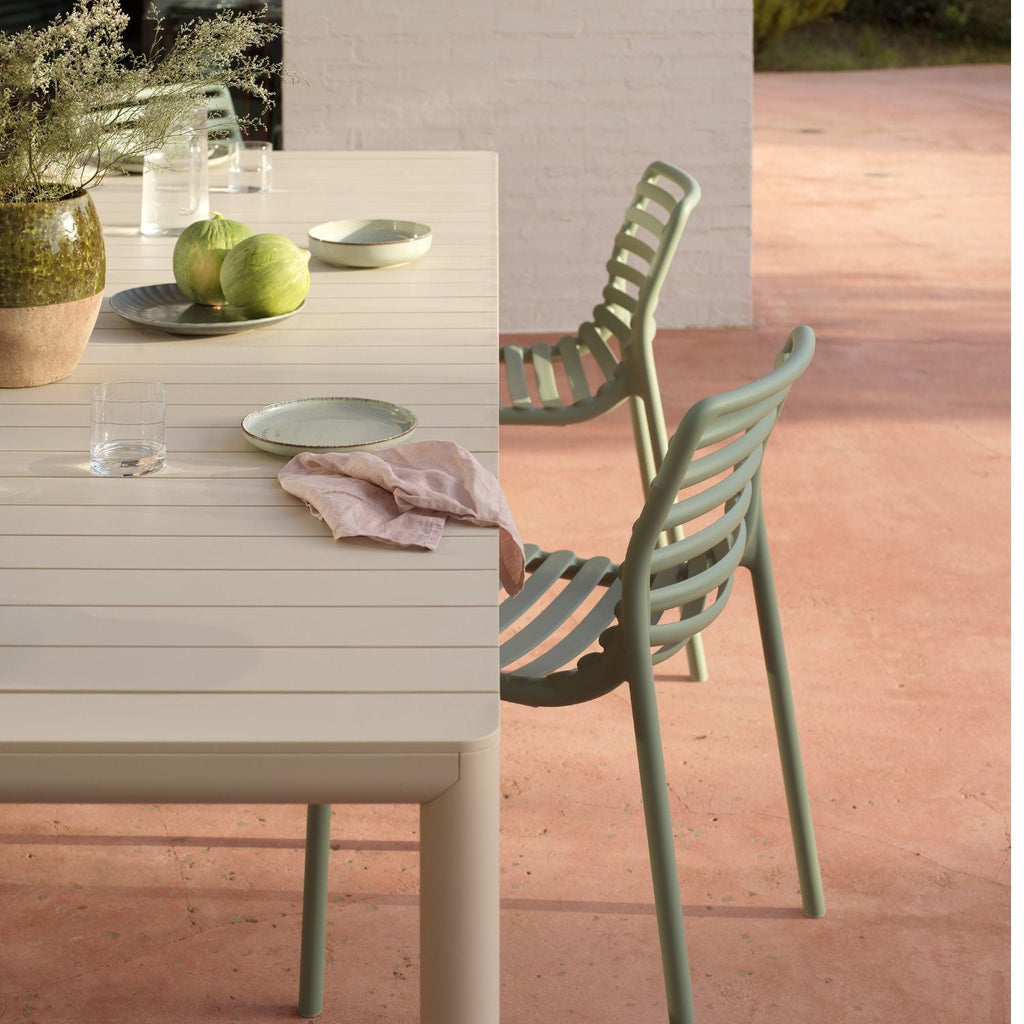
Chairs. Stackable resin or aluminium chairs make the most of limited floor space. Moulded outdoor resin chairs stack, wipe clean and have no metal fixings to corrode, and the outdoor stackable dining chairs range suits tight storage.
Timber. Untreated timber on an exposed balcony can warp within a couple of summers. Teak holds up well but weathers to silver-grey and is heavier to move, so a teak balcony dining setting suits covered balconies better than exposed corners.
Feet, glides and drainage. Balconies sit over a waterproofing membrane. Plastic or rubber glides protect the tiles, stop water pooling under metal feet and cut the scraping noise your downstairs neighbour will notice first. Use drip trays under pots, because water left on the tiles can end up in the ceiling below.
Cushions. On a balcony dining setting, cushions that come off and store inside easily matter more than extra padding. They're the first thing to catch wind and the first to fade.
Getting It Up There: Lifts, Doors and Strata Rules
A balcony dining setting that doesn't fit in the lift is a problem you only discover on delivery day. Before you order, check:
The lift interior, including the diagonal, since long tabletops often travel on an angle.
Every door and corner on the route, including the balcony door when fully open. Sliding doors often open to less than their frame width.
How the table ships. Detachable legs are far easier to deliver than one-piece welded frames, and solid ceramic or concrete tops are heavy, so ask whether delivery includes carrying them up.
Then read your strata by-laws. A freestanding balcony dining setting is the safest approach: no drilling, nothing fixed to the balustrade, nothing permanent. It keeps you within body corporate rules and moves with you. Some buildings also restrict colours, umbrellas and screens visible from the street. With your measurements in hand, pair a table with outdoor balcony chairs that suit your depth, your wind exposure and your storage.
Balcony Dining Setting FAQs
What size balcony dining setting fits a small balcony?
Under 150 cm deep, place a 60 to 70 cm table along the balcony's length with a chair at each end, or choose a bar-height setting against the building wall. Between 150 and 200 cm, a 70 to 80 cm table with two chairs facing each other usually fits.
Is a round or square table better for a balcony?
Round tables have no corners, so they're easier to squeeze past and suit balconies where people need to reach the far end. On long, narrow balconies, a square or rectangular table set lengthways often uses the depth better.
How heavy can balcony furniture be?
Residential balcony slabs are typically designed for around 200 kg per square metre, so a table and two to four chairs is usually well within limits. The bigger risk is heavy planters lined along the edge, so keep heavy pieces near the building wall.
How do I stop balcony table and chairs blowing over?
Choose a heavier table, such as ceramic or concrete, and light chairs you can stack against the wall. Open or slatted chair backs catch less wind than solid ones. Bring the chairs in when a strong wind warning is issued.
Where should balcony chairs go if children visit?
Away from the balustrade. Keep a clear zone along the rail, store stacked chairs against the building wall or indoors, and keep bar stools, planters and storage boxes off the rail, since all of them can be climbed.
What's the best material for balcony table and chairs?
Powder-coated aluminium frames suit most balcony dining settings because they're rust-free, light and handle coastal air. Pair them with stackable resin or aluminium chairs to save floor space. Teak works on covered balconies but is heavier and weathers to silver-grey unless oiled.