





Recently viewed


Outdoor umbrellas from Remarkable Outdoor Living give your backyard, patio or balcony dependable shade that is chosen with Australian sun, wind and coastal air in mind. Every canopy, frame and base in the range is selected for UV resistance, weather-resistant construction and real-world stability. You'll find standard patio umbrellas, umbrellas with stands, garden umbrellas, patio shade covers, outdoor gazebo furniture, pergolas and dining umbrellas, offered in a range of colours and sizes. Shop the full Outdoor Umbrellas & Stands collection online, or see the canopies and bases up close at our showrooms in Sydney, Melbourne, Brisbane, the Sunshine Coast and the Gold Coast.
UV levels across much of Australia sit among the highest anywhere, so shade over your outdoor area does more than keep you cool. It cuts UV exposure and lets you stay outside longer on hot days. That's why we focus on frames, fabrics and bases that cope with strong sun, salt-laden sea breezes and sudden gusts.
Materials across the range include sturdy aluminium, heavy concrete, durable outdoor fabrics, resilient resin and timber. Whether the umbrella will stand beside the pool, on a patio or deck, on a balcony, across the lawn or in the backyard, there's a design suited to the spot.
Which Outdoor Umbrella Suits Your Space?
The fastest way to narrow your choice is to start with the area you need to shade. Use the guide below to match your space to an umbrella type, then move on to size, fabric and base:
- Outdoor dining table: A centrepost umbrella slots through the hole in the middle of the table and spreads even shade over every seat. Choose a base rated for the canopy width.
- Pool, lounge or sun lounges: A cantilever umbrella holds the canopy from the side, so shade falls over a lounge setting or the pool edge with no pole in the way. Our Cantilever Umbrellas rotate and tilt to follow the sun.
- Balcony, terrace or small courtyard: A half umbrella sits flush against a wall or railing and takes up roughly half the floor area of a full canopy.
- Lawn and garden beds: Freestanding Garden Umbrellas on a weighted base can be shifted as the shade moves or when you change the garden layout.
- Coastal or consistently windy sites: Go for a heavy-duty umbrella with a vented canopy, anchor it with a fixed or heavily weighted base, and close it whenever nobody is using it.
- Large entertaining areas that need permanent cover: Pergolas can replace freestanding umbrellas or work alongside them.
Choosing Outdoor Umbrellas for Every Season in Australia
An Australian summer means strong UV and long, hot afternoons, and a well-chosen outdoor umbrella turns part of your garden into a comfortable place to sit through every season. Good shade reduces UV exposure while you're outside and gives the garden a more complete, organised look.
Start by getting familiar with the options. Heavy-duty models are made to stand up to rough weather, while large-format umbrellas cover wide areas. Some households prefer a straightforward 220cm square centrepost, while others want the extra coverage of a 400x300cm rectangular cantilever. Whatever the style, pairing the canopy with the right base is what gives you lasting stability. Fade-resistant fabrics that block harmful UV are another mark of quality outdoor umbrellas.
Shade is only part of the job. Outdoor umbrellas act as permanent garden fixtures that need to cope with Australian conditions and still make the space easy to use. Knowing what separates quality outdoor umbrellas from basic models helps you buy something that won't need replacing after a few summers.
What makes an umbrella suitable for outdoor use?
An umbrella that lives outdoors needs particular features to cope with the weather. The canopy fabric has the biggest influence on how well it performs and how long it holds up. On quality outdoor umbrellas, look for weather-resistant fabric that offers:
- UV protection - A canopy rated UPF 50+ sits in the top category of Australian sun-protective fabric ratings and blocks around 98% of UV radiation
- Fade resistance - With solution-dyed fabric, colour is added before the yarn is spun, so it runs through every fibre and holds up longer in strong sun
- Water repellency - Water-repellent, marine-grade canopy fabric helps shed rain and resist moisture
Frame construction deserves equal attention. Aluminium is a common choice because it's lightweight and rust-free, and both anodised and powder-coated finishes add a protective layer that helps the frame resist corrosion in humid and seaside locations.
Also check that your outdoor umbrella includes:
- Design details that help it handle wind
- Stainless steel hardware, ideally marine-grade 316
- Canopy vents that let wind pass through and reduce pressure
- A base heavy enough for the canopy size
Differences between indoor and outdoor umbrellas
Outdoor umbrellas and indoor or decorative umbrellas are built for very different jobs. An outdoor model uses resilient materials to handle sun, rain and wind, while indoor and decorative versions put appearance ahead of durability.
Scale is the next point of difference. Outdoor umbrellas are made larger so they can cover garden furniture and a group of people, and they come in round, square and rectangular canopies to fit different spaces.
They also carry practical features that indoor versions don't need. Many outdoor models tilt so you can block the sun as it moves across the sky, and they commonly include:
- A crank lift that makes opening and closing easy
- A vented canopy that improves airflow and steadiness in wind
- A weighted base or installation fittings that keep the umbrella secure
Portability differs as well. Indoor umbrellas are light and easy to carry, whereas outdoor versions are either permanent fixtures that stay out in all weather or semi-permanent models sitting on heavy, stable bases.
Keep these points in mind when choosing an outdoor umbrella for your garden. An exposed, windy spot usually calls for a heavy-duty umbrella, while a lighter model may be enough for a sheltered corner that you only use occasionally.
Types of Outdoor Umbrellas for All-Season Use
Choosing the right style has a real effect on how comfortable your outdoor space is across the seasons. Each design suits particular spaces and weather conditions.
Centrepost umbrellas
The centrepost umbrella is the design most people picture first. A single pole runs up the middle and supports the canopy, and that simple, practical layout is why it's still widely used.
Cafes and restaurants rely on this style to shade outdoor dining tables, and many models include a sturdy commercial-grade winder handle for easy opening.
You can choose octagonal or square canopies, with lift systems ranging from basic manual designs to pulley mechanisms. Because the pole passes straight through the centre of a dining table, a centrepost umbrella and table together form a complete outdoor dining setup.
Cantilever umbrellas
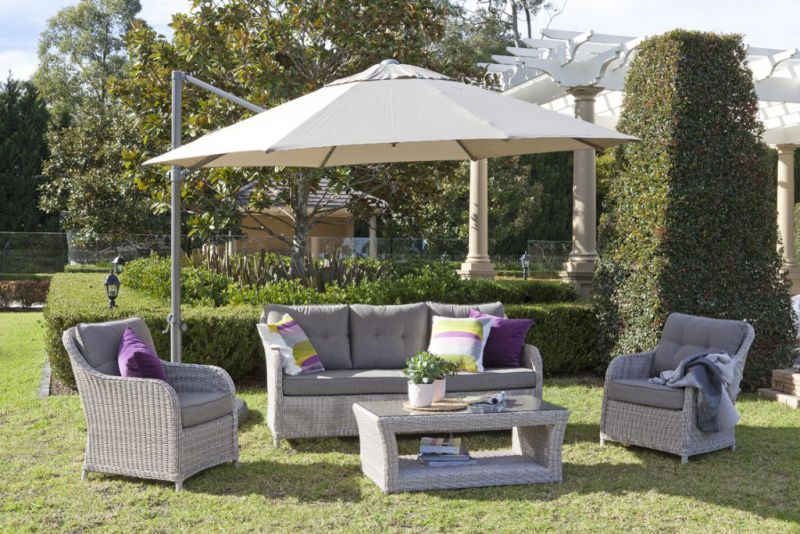
Cantilever umbrellas are now a common sight in Australian backyards. The canopy hangs from a pole set to one side, which is why you'll also hear them called side-post umbrellas. With no pole in the middle, they give clear, unblocked shade over furniture or a swimming pool.
The main advantages of cantilever umbrellas are that they:
- Can be placed wherever you like, with no centre pole underneath
- Shade a larger area
- Swivel side to side and tilt to different angles
- Track the sun as it moves through the day
A quality cantilever model rotates 360 degrees and tilts with little effort, so you can keep the shade where it's needed as the sun sits higher in summer and lower in winter.
Half umbrellas for small spaces
For compact gardens, balconies and terraces, a half umbrella is a practical fix. It needs about half the space of a standard canopy yet still casts useful shade.
Most half umbrellas use a winder mechanism for simple opening and closing, and their flat-backed design suits tight spaces in every season where a full umbrella simply wouldn't fit. For a small area, our Outdoor Balcony furniture range pairs well with a half umbrella.
Heavy duty outdoor umbrella options
Heavy duty outdoor umbrellas are made for sites where the weather is tougher than average. Often described as commercial umbrellas, they use stronger frames and fittings than standard garden models.
Wind resistance is where these umbrellas earn their place. Many come with a manufacturer wind rating, so read the stated figure and check which base or installation method it assumes, especially for coastal and exposed locations. Commercial-grade versions often combine marine-grade stainless steel fittings with corrosion-resistant bases.
Upkeep is minimal, and some models add built-in lighting so the area stays usable after sunset.
Choosing the Right Size and Shape
Getting the dimensions right matters as much as picking the type. The size and shape of the canopy decide how much shade you get, how well it fits the space and how it looks in your garden.
Small, medium, and large outdoor umbrella options
Outdoor umbrellas generally fall into four size groups, each suited to a different setting:
Small umbrellas (about 180cm to 230cm) work for balconies and café-style seating for two. They sit on lighter bases, around 16kg for a 180cm umbrella, so they're easy to reposition.
Medium umbrellas (about 240cm to 270cm) are the most flexible size and suit standard patio tables for four to six people. Expect to use a base of around 18kg to 29kg, depending on the canopy.
Large umbrellas (about 300cm to 340cm) cover bigger gatherings, shading tables up to about 160cm wide or seating for six to eight. They need heavier bases of around 29kg to 34kg to stay put when the weather turns.
Extra-large umbrellas (over 350cm) give the widest coverage and suit large outdoor furniture settings.
Round vs square canopies
Canopy shape changes both how much shade you get and how the umbrella looks.
For the same width, a square canopy provides about 27% more shade than a round one. A 300cm square umbrella covers about 9 square metres, while a 300cm round umbrella covers about 7 square metres.
Round canopies cast a circular patch of shade and cope with wind better thanks to their shape. They sit naturally with traditional gardens and round tables.
Square canopies push shade right into the corners and fit neatly against walls and into corners. They suit contemporary outdoor spaces, although the corners catch more wind than a round canopy.
How to match umbrella size to your garden layout
Measure your table or seating area before anything else. As a guide, the canopy should reach at least 60cm beyond the table edge on every side to keep everyone shaded.
Table shape changes the calculation:
- Round tables: choose an umbrella 120cm wider than the table's diameter
- Square tables: allow 60cm of canopy past each edge
- Rectangular tables: make sure the canopy extends 60cm past the long sides
Height matters too. Leave at least 210cm between the ground and the lowest edge of the canopy so people can walk underneath comfortably.
In most cases the umbrella should sit centred over the table or seating, unless you have a clear reason to offset it. If you're buying a table and umbrella together, pick the table from our Outdoor Dining Sets range first, then size the canopy to suit it.
Features That Matter in All Seasons
A simple canopy on a pole won't cope with every kind of weather. The features below keep quality outdoor umbrellas useful in every season, from blocking harsh sun to lighting the space at night.
UV protection and fade-resistant fabrics
Performance canopy fabric is your first line of defence against the sun. Check for a stated UPF rating, which tells you how much UV the fabric blocks. Given Australia's high UV levels, a UPF 50+ canopy made from solution-dyed fabric helps protect you and keeps its colour for longer.
Water resistance and mildew control
Quality canopies are treated with a water-repellent coating so rain runs off rather than soaking in. They also resist mould and mildew, which is important in humid and coastal regions. Many models include air vents and designs that shed water, stopping it from pooling and helping the umbrella stay steady in wind.
Tilt and rotation mechanisms
As the sun's angle shifts through the seasons, being able to follow it becomes essential. The common tilt options are:
- Collar tilt: twisting a collar above the crank handle angles the canopy
- Push-button tilt: pressing a button near the top of the pole lets you adjust it by hand
- Crank tilt: the handle used to open the umbrella also sets the angle
Many cantilever umbrellas also rotate 360 degrees, so you can move the shade to exactly where you want it without shifting the base.
Built-in LED lighting for night use
Integrated LED lighting keeps outdoor umbrellas working after dark. Solar-powered versions charge in daylight and turn on automatically at dusk, and some come with a remote or smartphone app for adjusting brightness and colour. It can reduce the need for separate outdoor lighting and makes the space more practical in the evening.
Bases and Stability Considerations
Every outdoor umbrella relies on a solid base. How securely it's anchored decides how safe it is, so give the base as much thought as the canopy. Our Outdoor Umbrella Bases help you match the right weight to your canopy size.
Choosing the right outdoor umbrella with base
Base weight should scale with canopy size. As a general guide:
- 180cm to 270cm umbrellas: bases of around 16kg to 23kg
- 300cm to 340cm umbrellas: bases of around 23kg to 34kg
- Umbrellas over 350cm: bases of at least 43kg
If the umbrella passes through a table, the base can be about 9kg lighter because the table adds support. In windy areas, add at least 7kg to these figures.
Umbrella stands vs fixed installation
The way you mount the umbrella affects both stability and convenience. A portable umbrella on a weighted stand can be moved around the garden, while a fixed installation suits permanently windy spots and outdoor areas that won't change.
Weighted bases come in three main types: water-fillable (easy to move but lighter), sand-fillable (heavier and steadier) and concrete (very stable and suited to semi-permanent setups). Steel base plates help keep portable umbrellas planted in wind.
For the greatest stability, fixed options include:
- In-ground bases: set into concrete footings with purpose-made fittings
- Bolt-down bases: fixed to a concrete slab at least 10cm thick
- Deck mounting: requires additional timber joists for reinforcement
Fixed bases are the better choice for large umbrellas, cantilever models and sites that are regularly windy.
Wind resistance and safety tips
No base makes it safe to leave an open umbrella unattended in strong wind. In many parts of Australia, afternoon storms and coastal gusts can build quickly, and a wind-rated umbrella only performs as intended when it's properly secured.
Keep these safety points in mind:
- Close the umbrella whenever it isn't in use
- Avoid freestanding umbrellas on high balconies and rooftops
- Match the base footprint to the canopy size
- In windy spots, a centrepost umbrella can be steadier than a cantilever
A well-made umbrella can still become a hazard if it isn't anchored correctly.
Pairing Outdoor Umbrellas With Your Outdoor Furniture
Outdoor umbrellas perform best when they're chosen together with the furniture underneath. Around the dining table, size a centrepost or cantilever umbrella using the measurements above. Beside the pool, set a cantilever next to Outdoor Daybeds & Sun Lounges so you can angle the shade across the loungers as the afternoon sun drops. On a balcony, a half umbrella keeps the floor free for a compact table and chairs.
Outdoor Umbrellas FAQs
Can outdoor umbrellas stay outside in winter?
Many outdoor umbrellas are built to stay outdoors, but closing the canopy and fitting a cover when it's not in use reduces wear from wind, rain and UV. In exposed or windy spots, storing the umbrella during long breaks is a sensible step.
How do I clean an outdoor umbrella canopy?
Brush away loose dirt, then hose the canopy down or wipe it with mild soapy water and rinse. Leave it open until it's completely dry before closing it, which helps prevent mould and mildew.
Are cantilever umbrellas suitable for windy areas?
Yes, as long as they're paired with a heavy or fixed base that suits the canopy size. In consistently windy locations, a centrepost umbrella or an in-ground cantilever installation is often the steadier option.
Finding the Right Outdoor Umbrella for Your Garden
The right choice depends on how your garden is laid out and what the local weather throws at it. Weigh up size, shape, material quality and stability, and you'll end up with an umbrella that works through all Australian seasons.
A quality outdoor umbrella is a considered, long-term purchase. The better models provide reliable UV protection, handle the weather and stay steady in difficult conditions, and many tilt and rotate to follow the sun through the day and across the seasons.
Even a well-designed umbrella falls short, and can become unsafe, when it isn't properly stabilised. Pairing it with the correct base is essential for both safety and everyday use.
Whether you lean towards a classic centrepost, a flexible cantilever or a space-saving half umbrella, it should suit both your space and your conditions. Get that right and you'll have a comfortable spot to sit through intense summer heat or a passing shower.
Before you buy, check the garden layout, measure the furniture you want to shade and think about how you'll use the area in each season. A well-chosen outdoor umbrella does more than provide shade, it opens up more of your outdoor space for everyday use.