





Recently viewed


Patio Umbrellas: The Complete Buying Guide for Your Outdoor Space
Patio umbrellas range from compact 135 cm models to expansive 350 cm canopies. The right one requires more than a colour you like. You need to think about the umbrella for patio table sizing, base weight requirements and durability features. Finding the best outdoor umbrellas means you understand how different types work with your space. This guide covers everything from patio umbrella selection with base to maintenance tips and helps you make an informed decision for your outdoor area.
Types of Patio Umbrellas
Understanding the different types helps you match a patio umbrella to your specific outdoor setup. Each design addresses distinct spatial challenges and shade requirements.
Centre Post Umbrellas
Centre post umbrellas feature a vertical shaft running through the middle of the canopy. This design gives you exceptional stability and works well for outdoor seating arrangements where the umbrella sits in the table centre. The structure allows plenty of room for patio chairs underneath and provides direct overhead coverage.
These patio umbrellas use a push lift or push pulley system to open and close the canopy. The canopy has a vent and finial. The design prioritises durability over adjustability. You will find them shading individual seating sets rather than entire patio areas. You can move and store them when not in use. This gives you flexibility for seasonal shade solutions.
Cantilever (Offset) Umbrellas
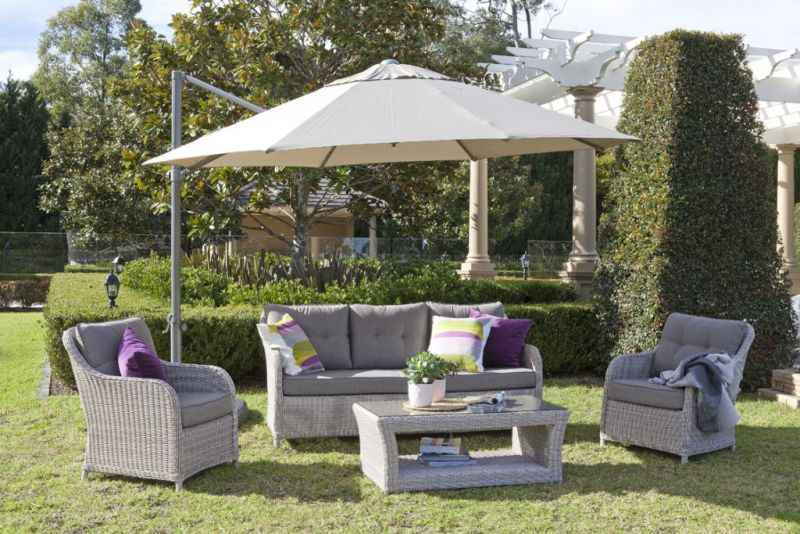
A cantilever patio umbrella suspends the canopy from a side-mounted arm and eliminates the centre pole. This configuration leaves the space underneath unobstructed, which solves the problem of furniture placement around a vertical support.
The offset design requires substantial base weight to counterbalance the extended canopy load. You will need a base weighing 90 to 180+ kg or a permanent mounting system. This engineering challenge results in a more robust construction compared to centre post models, but the design pays for itself in usability in spaces where a centre pole cannot go.
Most cantilever models rotate 360 degrees and tilt in multiple directions. This adjustability lets you track the sun throughout the day without moving your seating arrangement. Pool decks benefit from this design since you can position shade across lounge areas without placing a pole between chairs. Outdoor sectionals and hot tub surrounds also gain functional advantages from the clear coverage zone.
Market Umbrellas
Market umbrellas trace their origins to Italy and France, where merchants used them to protect street vendor stalls from scorching heat. The name stuck as these umbrellas became fixtures at farmers markets and outdoor kiosks.
The physical structure consists of a straight pole positioned at the patio umbrella's centre and attaches to the middle of the canopy. Market umbrellas maintain a rigid, symmetrical design without tilting mechanisms. They use a push-and-pop mechanism for smooth opening and position securing. The shaft is made from timber or steel, with canopies available in octagonal, square, or rectangular shapes using UV-resistant materials like solution-dyed acrylic or solution-dyed polyester fabric.
One defining characteristic sets market umbrellas apart: they lack decorative valances. This absence makes them easier to sit under at smaller tables, especially for commercial applications. The canopy has wind vents to provide ventilation. The rigid construction makes them suitable for high-wind areas.
Specialty Umbrellas
Several specialised designs address unique outdoor requirements. Half umbrellas fit smaller spaces like balconies or against walls and function as a standard patio umbrella cut in half. Urban dwellers with limited outdoor space benefit from these lightweight designs that mount against railings.
Sail umbrellas create a modern aesthetic using durable fabric stretched between anchor points. These cover large areas and provide UV-resistant, water-repellent protection with easy seasonal storage.
Beach umbrellas feature pointed ground spikes for insertion into sand or soft soil. Their lightweight aluminium or fibreglass construction prioritises portability over permanent installation.
Commercial patio umbrellas handle heavy-duty use in public spaces with high-grade aluminium or steel frames and reinforced construction for stability. Solar-powered models integrate LED lighting through built-in panels that absorb sunlight during the day.
Key Features to Consider When Choosing Best Outdoor Umbrellas
You should not need excessive effort or complicated procedures to operate your patio umbrella. The mechanisms that open, close and adjust your canopy affect daily usability and long-term satisfaction.
Lift Mechanisms
Push-lift systems use a manual sliding mechanism that locks into place once you extend the canopy. This straightforward approach works well for smaller umbrellas but requires physical strength for larger models. You push up on the hub until the umbrella locks or secures with a locking pin.
Crank lift systems rotate a handle to raise and lower the canopy. This mechanism provides precise control over umbrella position and reduces finger-pinching risks compared to push-button mechanisms. The gradual operation puts less strain on the frame and extends the patio umbrella's lifespan. But crank systems involve more moving parts that can wear out over time. Opening the umbrella takes longer than simpler mechanisms.
Pulley lift umbrellas use a rope and pulley system, found on larger and stronger models. You pull on a rope hanging beside the pole to raise the canopy, then secure it with a locking pin. The simple design proves durable with fewer mechanical parts that can break. The biggest drawback involves the physical effort required and potential rope fraying over time.
Tilt Options
Push-button tilt mechanisms allow fixed-angle adjustment in one direction. You press a button to release the lock and adjust the patio umbrella's angle with minimal effort. This straightforward system works well but may have a limited tilt range.
Auto-tilt umbrellas activate the tilt feature at the handle. They prove especially useful when the umbrella sits inserted into a patio table. The mechanism works through the crank system and lets you adjust from your patio chair without reaching high.
Collar tilt mechanisms position the adjustment point at the crank's collar. This provides a full range of tilt angles for better sun-blocking flexibility. The collar sits high on the pole, which can be difficult to reach for shorter users.
Rib Materials
Ribs hold the fabric down and maintain umbrella shape. Aluminium ribs are a lightweight alternative that flexes better than timber and withstands wind gusts. These ribs resist corrosion through powder coating or anodisation.
Fibreglass ribs prove significantly stronger and lighter than traditional timber or metal ribs. Wind tests show fibreglass ribs bend and flex during winds that would break other materials. These patio umbrellas withstand winds over 80 km/h and outlast steel or timber ribbed umbrellas considerably.
Canopy Design
Vented canopies feature openings that allow wind to pass through rather than catching underneath. This double canopy design reduces the risk of the patio umbrella flipping or sustaining damage during gusts. Wind resistance improves through the combination of rib material and frame construction with proper base stability.
How to Choose the Right Size Umbrella for Patio Table
Your table dimensions determine which patio umbrella size provides adequate protection without overwhelming your space. Get this wrong and you will have insufficient shade or an awkward setup that disrupts your outdoor area's flow.
Measuring Your Space
Clear any items from the area that might interfere with accurate measurements. Take a tape measure and record the width and length of the zone you want to shade. Pull out your dining chairs to account for occupied seating, since your umbrella needs to cover people, not just furniture.
Your patio umbrella should extend at least 60 cm past your table or seating area on all sides. This overhang accounts for the sun's changing angles throughout the day. At noon, a centre-pole umbrella casts shade directly beneath it in a circular pattern matching its diameter. That same umbrella throws an elongated shadow by mid-afternoon that may miss part of your seating area. The 60 cm buffer compensates for this change.
Measure your seating area and add 120 cm total (60 cm on each side) to calculate your minimum umbrella size. A seating area spanning 150 cm therefore needs at least a 270 cm patio umbrella for proper protection.
Coverage Area Guidelines
The relationship between table size and umbrella diameter follows predictable patterns. Round tables need your umbrella to surpass the table's diameter by at least 120 cm total, providing 60 cm of shade around the perimeter. Square tables require a similar approach, with the umbrella stretching at least 60 cm beyond each side. Rectangular tables need the umbrella extending past the longest sides by 60 cm.
Here is how table dimensions match to umbrella sizes:
| Table Size | Seating Capacity | Recommended Umbrella Size | Coverage Area |
|---|---|---|---|
| 90 cm | 2-4 people | 210-270 cm | ~3-4 m² |
| 107-120 cm | 4 people | 270 cm | 5-6 m² |
| 120-135 cm | 4-6 people | 270-340 cm | 6 m² |
| 150 cm | 6 people | 340 cm | ~9 m² |
| 180+ cm | 6-8 people | 340-400 cm | 9+ m² |
A 270 cm patio umbrella creates approximately 6 m² of shade coverage at midday, making it the most popular size for residential patios. Larger dining sets need 300 cm umbrellas that provide around 7 m².
Height Requirements
You need at least 210 cm of clearance beneath the umbrella canopy for comfortable movement. This minimum allows guests to sit and stand without hitting their heads. Standard umbrella poles measure 210 to 240 cm tall, though most range between 210 and 300 cm from base to canopy top.
Centre the patio umbrella over your table to distribute shade evenly. Leave enough space around the table so chairs can be pulled out without bumping into the base or pole.
Essential Components: Patio Umbrella with Base Selection
Base selection determines whether your patio umbrella with base stays secure in place or becomes a safety hazard. Five factors control this decision: pole diameter, base weight, base material, fill type, and your patio surface.
Understanding Base Weight Requirements
The standard calculation requires at least 23 kg for every 210 to 240 cm of umbrella canopy diameter. Coastal regions and exposed areas have wind conditions that intensify, so go heavier there.
Cantilever umbrellas demand much more weight. The canopy arm extends sideways and creates an off-centre load with no vertical pole anchored beneath it. You will need bases weighing 90 to 180+ kg for these offset designs. Your patio umbrella sits through a patio table, and the table provides lateral support that reduces required base weight. A 15 to 23 kg base is sufficient for a 270 cm umbrella for patio table mounted this way.
Wind exposure amplifies weight needs. Areas that experience frequent high winds need a heavier base, regardless of the canopy diameter. Balcony and rooftop installations face higher wind exposure off the ground. They require flat, low-profile bases that will not tip in tight spots. Check your balcony's rated weight limit before adding a heavy sand-filled base.
Base Types and Styles
Material affects weight, durability, and climate performance. Cast iron bases deliver heavy, strong foundations with enamelled finishes that resist rust in high-humidity areas. Heavy-duty concrete bases often come covered in powder-coated steel and provide sturdy, rust-resistant support.
Moulded resin bases require fill material like water or sand for weight. Water makes the base easier to move and drains faster during storage. Sand delivers denser, sturdier performance in windy weather. A sand and water combination delivers the most stable performance from fillable designs for maximum holding strength. HDPE proves effective for poolside or coastal setups where UV exposure and moisture pose ongoing concerns.
Matching Bases to Umbrella Types
Confirm your base's stem accommodates your patio umbrella pole diameter. The most standard pole diameter measures 4 cm, though some reach 8 cm wide. Many bases adjust for smaller sizes but do not expand for wider poles.
Offset umbrellas require dedicated cantilever bases built to handle lateral load distribution. Standard centre-pole bases will not work. Most cantilever bases use a cross or L-shaped footprint, and better models include built-in wheels for repositioning. Always buy a cantilever base recommended by or confirmed compatible with your umbrella's brand. Arm socket dimensions are not standardised across manufacturers.
Durability and Weather Resistance
Materials determine how long your patio umbrella survives outdoor conditions. Frame construction, fabric quality and wind-resistant features separate umbrellas that last from those requiring replacement after one season.
Frame Construction Materials
Marine-grade aluminium and fibreglass combinations outperform decorative hardwood frames in windy conditions. Aluminium poles resist rust, though hardware, screws and rivets remain susceptible to corrosion. Fibreglass ribs flex under pressure and return to their original shape, which reduces structural stress during wind events.
Hardwood poles from teak offer strong durability when treated properly. These poles require periodic maintenance with timber protectors or synthetic penetrating oil to maintain their finish.
Fabric Options and UV Protection
Solution-dyed acrylic blocks up to 98% of UV rays and delivers the strongest fade resistance available for patio umbrella canopies. The fabric resists mildew, water and stains. Solution-dyed polyester provides 98% UV blocking with strong fade and mould resistance. Olefin weighs 200 gsm and blocks 95% of harmful UV rays. All three materials perform well for outdoor use across Australian conditions.
Wind Resistance Features
Vented canopy construction reduces pressure on the canopy and extends lifespan compared to traditional umbrellas. Close your patio umbrella after you finish using it, as wind damage remains the most common source of broken frames.
Maintenance and Care Tips
Store umbrellas in dry, protected areas or use waterproof covers during periods of non-use. Apply outdoor fabric protector to repel water and prevent UV fading. Check that water is not pooling inside the stand after rain, especially with timber poles.
Conclusion
The right patio umbrella balances size requirements, base stability and durability features for your specific outdoor space. Proper sizing requires measuring your seating area and adding at least 60 cm of overhang on all sides, as covered in this guide. Your base weight needs to match your umbrella type. Cantilever models require 90+ kg of support.
Review your space, wind conditions and usage patterns before you purchase. The right patio umbrella enhances your outdoor area and withstands weather challenges across many seasons. Match these technical requirements with your aesthetic priorities for a well-considered choice.
FAQs
Q1. What is the difference between a cantilever and a centre post patio umbrella? A centre post umbrella has a vertical pole running through the middle of the canopy, making it ideal for placement through table centres. A cantilever umbrella suspends the canopy from a side-mounted arm, leaving the space underneath completely unobstructed. Cantilever models require heavier bases (90 to 180+ kg) but offer 360-degree rotation and better flexibility for furniture placement.
Q2. How do I determine the right umbrella size for my patio table? Measure your seating area and add 120 cm total (60 cm on each side) to find your minimum umbrella size. For example, a 120 cm table seating four people needs a 270 cm patio umbrella. The umbrella should extend at least 60 cm past your table on all sides to account for the sun's changing angles throughout the day and provide adequate shade coverage.
Q3. How much should my umbrella base weigh? The standard guideline is at least 23 kg for every 210 to 240 cm of canopy diameter. A 270 cm patio umbrella typically needs a 35 kg base. Cantilever umbrellas require significantly more weight — between 90 to 180+ kg — due to their offset design. Increase base weight in windy areas or exposed locations.
Q4. What umbrella fabric provides the best UV protection? Solution-dyed acrylic blocks up to 98% of UV rays and provides the strongest fade resistance available for patio umbrella canopies. It also resists mildew, water, and stains. Solution-dyed polyester offers similar 98% UV blocking with strong fade resistance, while olefin blocks 95% of UV rays. All three materials provide excellent sun protection for outdoor use.
Q5. How can I make my patio umbrella more wind-resistant? Choose patio umbrellas with fibreglass ribs that flex and return to shape rather than breaking in wind. Select vented canopy designs that allow wind to pass through instead of catching underneath. Ensure your base meets or exceeds weight requirements for your umbrella size. Most importantly, always close your patio umbrella when not in use, as wind damage is the leading cause of broken frames.