





Recently viewed


Large Outdoor Umbrella: Sizing, Shape and Wind
A large outdoor umbrella is sized from the furniture underneath it, not from the area you want to cover. Get that relationship right and everyone stays shaded as the sun moves; get it wrong and people spend the afternoon shifting their chairs. This guide works through coverage first, then shape, post type, and the base and wind question that decides whether a large outdoor umbrella survives its first serious blow.
Size It From the Furniture
The rule is straightforward: the canopy should extend 60 to 90 cm past the edge of the table or seating on every side. That overhang is what keeps people shaded as the sun angle changes through the afternoon.
A bistro table around 120 cm wide suits a canopy of 200 to 250 cm.
A table for four to six, around 150 cm, suits 250 to 300 cm.
A table for six to eight, around 200 cm, suits 300 to 350 cm.
A single sun lounge suits 240 to 270 cm. Larger lounge groupings need 330 to 400 cm.
Large pool decks and entertaining areas often need 400 to 500 cm, or more than one umbrella to avoid gaps between shaded zones.
Also allow around 50 cm of clear space around the umbrella itself so chairs can move and air can circulate. Measure with the furniture cleared out of the way, then put it back and check the overhang against where people actually sit. Browse the full <a href="https://www.remarkablefurniture.com.au/collections/outdoor-umbrellas-shade-heaters">Umbrellas Shade & Heaters</a> range to see how the sizes compare in practice.
Shape Changes Coverage More Than Size Does
This is the part that catches people out, because square and octagonal umbrellas are measured differently.
A square canopy is measured across its sides, so a 300 cm square covers roughly 9 m².
An octagonal canopy is measured across its corners, so a 300 cm octagon covers roughly 6 m².
Same stated size, noticeably different shade. Neither is wrong, but comparing them on the number alone is.
Match the shape to the furniture. Square canopies suit square and rectangular tables and sit neatly against walls. Round and octagonal canopies suit circular tables. Rectangular canopies suit long tables and narrow spaces, where a square would either overhang the walkway or leave the ends exposed. If you are still choosing the table, the <a href="https://www.remarkablefurniture.com.au/collections/outdoor-dining-settings">Outdoor Dining Sets</a> range lets you match both together.
Centre Post or Cantilever
The pole position determines how the space underneath works, so this decision comes before the size.
A centre post umbrella carries the canopy on a pole through the middle. It is more stable for its weight, needs a lighter base, and is the straightforward answer for a dining table with a centre hole. The pole occupies the middle of the space, which is fine at a table and awkward anywhere else. See the <a href="https://www.remarkablefurniture.com.au/collections/garden-umbrellas">Garden Umbrellas</a> range.
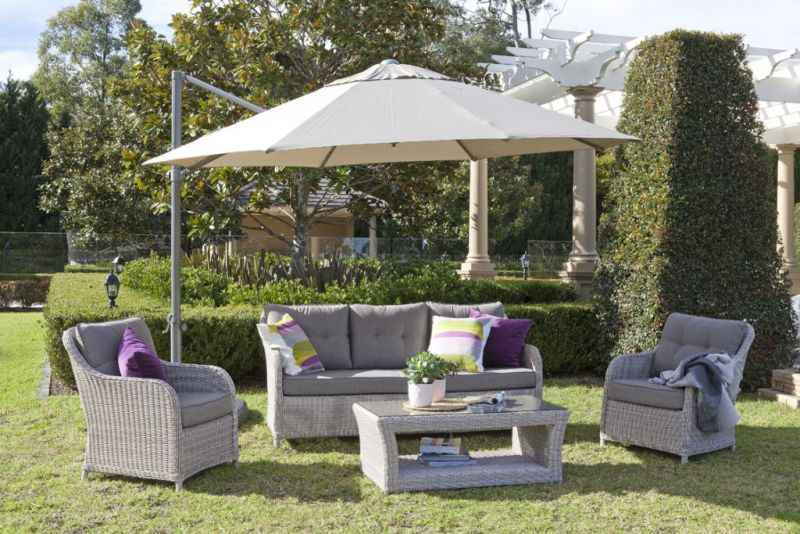
A cantilever umbrella carries the canopy from an offset pole at the side, leaving the area beneath completely clear. Most rotate through a full turn and tilt, so you can move the shade rather than the furniture. This is the format for poolsides, lounge settings and anywhere the shade needs to track the sun. The trade-off is that the load sits off to one side, so it needs a substantially heavier base. Compare the <a href="https://www.remarkablefurniture.com.au/collections/cantilever-umbrellas">Cantilever Umbrellas</a> range.
Where shade needs to be permanent rather than adjustable, a fixed structure is the other option worth weighing. The <a href="https://www.remarkablefurniture.com.au/collections/pergolas">Pergolas</a> range covers that.
Freestanding or Table-Integrated
Table-integrated umbrellas pass through the hole in a dining table and are held by the table itself plus a smaller base. Tidy, no separate footprint, and the obvious choice for a dining setting.
Freestanding umbrellas sit in their own weighted base and can go anywhere, which suits hard surfaces where you would rather not fix anything down.
In-ground or bolted mounting is the commercial answer and the most stable, though it commits the umbrella to one position permanently.
The Base Is the Part People Get Wrong
More umbrellas are damaged by an underweight base than by anything else. The canopy is a sail, and the base is the only thing holding it.
For a centre post umbrella around 270 cm, plan on a base of at least 23 kg. Larger centre post models want 34 kg or more.
For cantilever umbrellas the numbers jump. A 300 cm cantilever typically needs 68 to 79 kg, and a 330 cm model can need 100 kg or more.
Many cantilever designs use a ballast frame taking concrete blocks, commonly 25 kg blocks around 48 by 48 cm, so factor the assembled footprint into your layout.
Treat these as starting points and confirm the manufacturer's specification for the model you are buying, since canopy area and cantilever geometry both change the requirement.
Bases with wheels or handles are worth having on anything you plan to reposition. Compare the <a href="https://www.remarkablefurniture.com.au/collections/outdoor-umbrella-bases">Outdoor Umbrella Bases</a> range, and the broader <a href="https://www.remarkablefurniture.com.au/collections/outdoor-umbrellas">Outdoor Umbrellas & Stands</a> range where base and canopy are matched.
Wind Vents, Tilt and Rotation
Wind vents are the openings at the crown that let air pass through instead of pushing against the canopy. They reduce lift and are the single most useful feature on an exposed site. Double-vent systems handle more than single vents.
Ask for the wind rating rather than assuming one. Models vary enormously, and residential and commercial-grade umbrellas are built to different standards. A rated figure is a specification you can hold a supplier to; a general claim of durability is not.
Tilt comes in three common forms. Collar tilt turns a mechanism around the pole. Push-button tilt adjusts by hand at the canopy. Crank tilt is built into the opening mechanism and is the easiest to operate one-handed.
Rotation matters mostly on cantilever models, where turning the canopy through a full circle lets you follow the sun without moving the base.
Whatever the rating, close and secure the umbrella when you are not using it and before any forecast blow. No canopy is designed to be left open through a storm.
Frame and Canopy Materials
Aluminium is light, does not rust and handles coastal salt air, which makes it the default for most residential positions. Anodised finishes add a further barrier.
Timber, usually a dense hardwood, stays cooler to the touch than metal and suits sheltered positions. It needs periodic re-treating to stop the surface breaking down.
Steel carries more weight and more strength, which suits permanent and commercial installations. Powder-coating protects it, though any scratch through the coating needs attention before it corrodes.
For the canopy, solution-dyed acrylic carries colour through the fibre rather than printing it on the surface, so it holds up to sustained UV far better than surface-dyed fabric. Olefin is the lighter-duty alternative. Ask for the fabric's UV rating rather than relying on a general claim, since it is a measurable figure and reputable canopies have one.
Rib count affects how the canopy holds its shape under load. Eight is standard; higher counts spread the load further across the fabric.
If the shaded area gets used into the evening, the <a href="https://www.remarkablefurniture.com.au/collections/outdoor-electric-radiant-heaters">Electric Radiant Heaters</a> range extends the hours it works for.
Care and Storage
Wash the canopy with mild soapy water and a soft brush. Skip harsh cleaning products, which strip the fabric's protective finish and leave it marking more easily afterwards.
Let the canopy dry completely before closing or covering it. Closing a wet umbrella is how mildew starts.
Check the frame for corrosion at the joints and where components meet, and rinse salt off if you are near the coast.
Sand and re-treat timber frames when the surface starts breaking down.
Store the umbrella closed, ideally in a cover, through winter and extended wet stretches.
Common Questions
What size large outdoor umbrella do I need?
Measure the table or seating, then add 60 to 90 cm on each side. A 150 cm table wants 250 to 300 cm of canopy; a 200 cm table wants 300 to 350 cm.
Cantilever or centre post for a pool area?
Cantilever. The offset pole keeps the area under the canopy clear and lets you rotate and tilt the shade as the sun moves, without a pole in the way.
How heavy does the base need to be?
Around 23 to 34 kg for a centre post model, and 68 to 100 kg or more for a cantilever, depending on canopy size. Always check the figure specified for your model.
Can it stay open in wind?
Close it. Wind vents reduce lift and a rated frame handles more, but no umbrella is built to be left open through strong wind, and an open canopy will take the base with it.
Which canopy fabric lasts longest?
Solution-dyed acrylic, because the colour runs through the fibre. Ask for the UV rating rather than accepting a general durability claim.
Getting the Coverage Right
Measure the furniture first and add the overhang, since that is the number that decides everything else. Choose the shape to match the table rather than comparing canopies on their stated size. Pick centre post for a dining table and cantilever for a poolside or lounge area. Then specify the base from the manufacturer's figure, not from what looks heavy enough, and close the umbrella when you are not under it.
Visit a Showroom
Canopy scale is genuinely hard to judge on screen, and the difference between a 250 cm and a 300 cm umbrella is obvious in person and invisible online.
Outdoor Furniture Sunshine Coast