





Recently viewed


Outdoor Swivel Armchair: What to Check Before You Buy
An outdoor swivel armchair turns on its base so you can face the view, the table or the conversation without shifting the chair. That rotating mechanism is also the part most exposed to weather, which makes buying an outdoor swivel armchair a different exercise from buying a fixed one. Everything below works outward from that mechanism: how it is built, what the frame does around it, how much clearance it needs, and what keeps it turning smoothly.
The Swivel Mechanism Is the Part That Fails First
A fixed chair has nothing to seize. An outdoor swivel armchair has a bearing race, a pivot plate and fixings sitting directly under the seat, taking rain, salt and grit. Three things separate a mechanism built for outdoors from one that is not.
Sealed or corrosion-resistant bearings. Open steel bearings pick up moisture and grit and start to grind. Sealed units, or bearings in stainless or coated steel, keep turning.
Stainless or coated fixings throughout. Untreated fasteners rust from the inside of the assembly, and by the time it shows on the surface the movement has already stiffened.
Drainage under the seat. Water has to leave the mechanism housing rather than pool in it. This is the single easiest thing to overlook and the hardest to fix later.
Ask about the base assembly specifically, not just the frame. Two chairs with identical powder-coated aluminium frames can carry very different mechanisms underneath.
Swivel, Rocker or Fixed
Worth settling early, because it changes which collections you should be looking at.
A swivel base rotates on the spot, usually through a full turn. It suits a position where the thing you want to face changes — the table, the pool, the sunset — and it works well at a round dining setting where seats aren't squared off to anything.
A swivel rocker adds a rocking motion to the rotation. More movement, more moving parts, and more to keep free of grit. Best under cover.
A fixed armchair has nothing to maintain and nothing to seize. If the chair will sit in one orientation permanently, facing a fixed view or a rectangular table, the swivel is paying for complexity you won't use.
Compare the options across the Outdoor Armchairs range before narrowing to a material.
Choose by Frame Material
Frame material decides how much attention an outdoor swivel armchair needs and how it behaves in the position you have.
| Frame | Best suited to | Upkeep |
|---|---|---|
| Powder-coated aluminium | Coastal, fully exposed, windy positions | Hose down, wipe with a damp cloth |
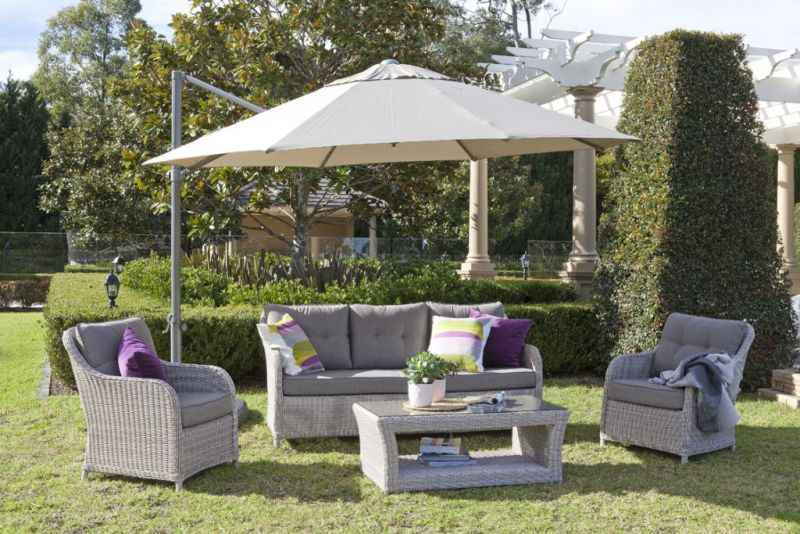
| All-weather wicker over aluminium | Open decks and paved areas wanting a woven texture | Hose down, brush the weave occasionally |
| Rope over aluminium | Exposed decks where solid surfaces get hot | Hose down, rinse salt off |
| Timber and teak | Sheltered and permanent positions | Oil periodically, or let it weather to grey |
Aluminium does not rust and takes powder-coating well, which is why it turns up as the subframe under most other outdoor materials. See the Outdoor Aluminium Armchairs range.
UV-stabilised synthetic wicker holds colour under strong sun far better than natural fibre and sheds water rather than holding it. Browse Outdoor Wicker Armchairs.
Rope and cord seating drains quickly and stays comfortable across a wide temperature range, which matters on an exposed deck. See Outdoor Rope Armchairs.
Teak and comparable hardwoods carry natural oils that help them handle exposure, though the weight suits a permanent position. Have a look at Outdoor Timber Armchairs.
Stability: Base Width and Weight
An outdoor swivel armchair sits on a smaller ground contact than a four-legged chair, so stability comes from base width and weight rather than footprint.
A wider base disc or star base resists tipping and handles uneven paving, decking boards and rug edges better than a narrow pedestal.
Heavier frames stay put in wind. Very light chairs on an exposed balcony or a high deck will move, and a swivel base gives wind something to work against.
On soft or uneven ground, check that the base sits flat. A pedestal that rocks on a paver will wear the mechanism unevenly.
If the chair lives on an open balcony, weight and base width matter more than anything on the specification sheet.
Clearance and Rotation Radius
This is where an outdoor swivel armchair differs most from a fixed chair in planning terms. The chair needs room to turn, not just room to sit.
Allow a rotation radius of around 60 cm measured from the centre of the base, so the arms and back clear walls, planters and neighbouring chairs through a full turn.
Leave at least 45 cm between the chair and any fixed object it rotates toward. Between 60 and 75 cm is more comfortable in daily use.
Seat height usually sits at 45 to 50 cm, with seat depth between 58 and 75 cm.
At a dining table, check that the arms clear the table edge through the full rotation, not just at the tucked-in position.
Mark the rotation circle on the ground with tape before ordering. It is almost always larger than people expect.
Cushions and Fabric
Water-repellent outdoor fabric is the sensible default. It sheds surface moisture, dries out after a shower and handles daily use, and solution-dyed acrylic and UV-stabilised outdoor fabrics hold colour under strong sun better than general upholstery fabric.
Check that covers are removable and washable and that foam cores are drainage-designed rather than solid. On a swivel chair, also check that the cushion is secured — ties or a fitted base stop it sliding off as the seat turns. Replacements and additions are available through Outdoor Chair Cushions.
Leather, velvet and similar upholstery belong indoors. Sustained sun and moisture will take them apart, whatever the chair is made of.
What to Put Beside It
A swivel chair is rarely a single purchase, because the whole point of the rotation is having something to turn toward.
A side table within arm's reach of the seated position at any rotation angle, which usually means placing it inside the turning circle rather than beside the arm. Compare heights across Outdoor Side Tables.
A footstool, roughly 90 by 55 cm, if the chair is a lounging position rather than dining seating.
A pair rather than a single, if the chairs face a fire pit, a view or each other. Swivel seating works hardest where there is more than one thing worth facing.
Keeping It Turning
Hose the frame and weave down every few weeks and wipe powder-coated surfaces with a damp cloth. Rinse salt off if you are near the coast. An outdoor swivel armchair asks very little beyond this.
Rotate the chair through a full turn regularly, even out of season. A mechanism that sits still is the one that seizes.
Rinse grit out of the base assembly rather than letting it build up under the seat.
Check the base fixings at the start of summer, before heavy use.
Use a fitted cover through wet stretches and storm season. The Outdoor Chair Covers range is sized for armchairs.
Common Questions
Can an outdoor swivel armchair stay outside permanently?
With a corrosion-resistant frame, an outdoor-rated mechanism and outdoor fabric, yes. Cushions last longer stored under shelter or protected with a fitted cover during extended wet periods.
Will the swivel mechanism seize up?
Only if it is neglected or built with untreated steel. Turning the chair regularly and rinsing grit out of the base assembly handles most of it.
How much space does one actually need?
Plan on a rotation radius of about 60 cm from the base centre, with 45 cm minimum to any fixed object, and 60 to 75 cm where you want it comfortable.
Do swivel chairs work at an outdoor dining table?
They suit round tables particularly well, since the seats aren't squared to anything. Check arm clearance under the table edge through the full turn before committing.
Which frame lasts longest near the coast?
Powder-coated aluminium, on its own or as the subframe under wicker or rope. Salt air is what shortens the life of most other metals.
Before You Order
Run through this and the shortlist settles itself. Confirm the mechanism is built for outdoor exposure and drains properly. Match the frame material to how exposed the position really is. Mark the rotation circle on the ground and check it against walls, planters and table edges. Choose base width and weight for the wind your position actually gets. Then check the cushion is secured and the covers come off.
Remarkable Outdoor Living specialises in outdoor furniture engineered for Australian conditions, with showrooms in Sydney, Brisbane, Melbourne, on the Gold Coast and on the Sunshine Coast.